I finally finished reading the New York Times's giant article on new source review and the Bush administration undermining thereof. The main thrust of the article -- that the administration has worked through administrative and bureaucratic, rather than legislative, means to implement its environmental agenda -- largely parallels my OSP article on the subject.
What I hadn't realized was that the new source review lawsuits that have been undermined by the rule changes are the first major enforcement actions taken since the Clean Air Act was passed. Obviously "but you let us get away with it before" isn't a valid excuse for wrongdoing. But there's also no excuse, morally or pragmatically, for the EPA's failure to monitor and enforce the law all along. We shouldn't be surprised at the degree of backlash when an industry that has been accustomed to not be held accountable suddenly gets hit with a reckoning 20 years in the making.
Stentor Danielson, 19:00,
Ranskaa On Hyvää
After making fun of French linguistic purity in internet terminology over at Matthew Yglesias, I should point out that I agree with Patrick Belton in liking the Parisian neologism "internaut" for "web surfer."
Stentor Danielson, 12:38,
Representatives of dozens of Islamic and African nations, as well as the Vatican, led the revolt against Annan's recent directive to offer medical, pension and other benefits for same-sex partners whose home governments have recognized their domestic partnerships.
... Iranian deputy representative Mehdi Danesh-Yazdi argued that the General Assembly — not Annan alone — should decide what constitutes a family. Saudi Arabian Ambassador Fawzi Shobokshi said that same-sex marriage was a taboo in all religions, and a "great evil" that threatened family unity.
If the UN starts recognizing gay marriage, then before you know it they'll be recognizing polygamy! It's a slippery slope.
Oh ... wait:
Under most U.N. regulations, marriage has been defined as a union between a man and a woman — or between a man and up to four women for countries where polygamy is legal. U.N. legal experts relied in part on that definition to include gay and lesbian staffers' partners.
On a more serious note, it's interesting that the arguments put forth against the policy include not only the consequentialist "damage to families" argument, but also the procedural-majoritarian argument that the policy is being implemented as an executive mandate based on legal logic, not as a result of a legislative vote.
Stentor Danielson, 12:10,
9.4.04
Here's Another Hilarious Article (HAHA)
Via Mithras, I found this story of a Canadian anti-gay group that didn't understand that photos in The Onion (which the group describes as a "gay paper") are fake. But the real tragedy is the group's name -- Simply Truths Our Priority, or STOP. It's another example of people creating awkward names for things in a misguided effort to have their acronym spell something.
Stentor Danielson, 21:47,
ID And The Limits To Science
Defenders of evolution frequently express frustration that Intelligent Design advocates won't offer a research program. They won't specify how design can be detected, much less how it can be used to advance our understanding of how species came to be the way they are. Instead they just recycle the same creationist arguments tearing down evolution, sans the overtly religious ones.
I can understand the frustration, especially given that in the political arena ID claims to be a theory of origins parallel to evolution. But thinking about the claim of "methodological naturalism" advanced by ID proponents, it seems to me that it might make more sense to see ID as a theory of the limits of science.
ID proponents claim that the theory of evolution is based on a commitment to methodological naturalism -- to considering only natural, not supernatural, factors in their explanations. This is true (as well as being true for physics, chemistry, economics, inegrated land-change science, etc.). But what does it mean for something to be "natural" or "supernatural"? We could simply define the categories by listing their members -- matter and waves and so forth are natural, gods and demons and magic are supernatural. If this is the case -- if there's no criterion on which we can differentiate the natural from the supernatural -- then charging "methodological naturalism" is a run-of-the-mill accusation of baseless prejudice against some class of phenomena.
But I think that we can see some rule for making the distinction between the natural and the supernatural. The natural is that which exhibits regularity (either deterministic or statistical). Think about what we imply when we say something is a miracle (literally or figuratively) -- we're suggesting that it was unpredictable, unreplicable, unexplainable. No wonder science is methodologically naturalistic -- it seeks to explain things, and supernatural causes are inexplicable.
Imagine the theory that some object was designed. If we want to probe farther -- to explore the why and how of the design -- we have to have some understanding of how the designer's mind works. We have to make hypotheses about the contextual conditions, logical processes, and desires of the designer. This is how archaeology works*. But in probing the designer's mind like this, we take the designer as being a natural phenomenon. The designer is presumed to follow some regularized -- and hence reconstructable -- principles. These principles can be tested by using them to predict what we'd find in another as-yet-unexamined case, and falsified if the additional evidence is inconsistent with the proposed model of the designer's thought process. But in this case, the argument about ignoring supernatural phenomena falls through, and we're left with an argument that evolutionary biology improperly regards god as supernatural.
Stephen Jay Gould's argument about the Panda's Thumb was an attempt to naturalize and refute one type of designer. Seeing that many opponents of evolution believed the designer to be an all-knowing and all-powerful god, Gould inferred that such a designer would be able to make optimal designs. But in cases such as the "thumb" of a panda, organisms' designs seemed to be jury-rigged in a way inconsistent with the hypothesized type of designer.
ID tends to avoid statements about the nature of the designer (i.e., they wouldn't rule out the idea of an incompetent designer to explain the panda's thumb). We're told it could be God, or it could be aliens, or it could be something else -- we don't know. In part, this can be seen as a shrewd political move, in order to keep God out of the picture. But it's also a necessary step to maintaining the claim that ID considers supernatural causes. When talking about a supernatural cause, you can't go much further than "there was one."
The inscrutability of the designer means that ID can't claim to be a scientific theory about the origins of species. Instead, it becomes a theory about the limits of science. In saying "the bacterial flagellum was designed," ID proponents are saying "science cannot (in the strong sense of "will never", rather than the weak sense of "hasn't yet") explain the origin of the flagellum." The idea of ID as a theory of the limits of science accords well with the fact that ID proponents focus on tearing down evolution rather than building up ID.
Religious creationism, it seems, can avoid both of the potential pitfalls of an ID that aspires to scientific status. On the one hand, because religion claims belief in a particular god(s) as well as knowledge about them, it can treat god as a natural phenomenon, and use various of god's attributes -- such as the aforementioned omniscience -- to generate hypotheses about how that god would have designed organisms. On the other hand, religion is willing, in a way science is not, to say that some things are inscrutable mysteries. It's this very loss of mystery that turns some people off to science -- here including psychology, ecology, and sustainability science as well -- in the first place.
*Well, some of archaeology, like the study of pottery and house plans. Archaeologists also try to explain non-designed patterns like the arrangement of settlements, though these may arise from lower-level design decisions (in this case, individual residential decisions).
Stentor Danielson, 18:09,
8.4.04
My Publications
From this week's Scarlet:
You might also want to take a look at my commentary, "Bush's EPA: More Mercury, Less Justice" and its comic. Then again, you may not want to if you read my previous posts on environmental justice -- it's more or less a poor rewrite of them with a hook into the mercury emissions standards proposal.
Stentor Danielson, 23:37,
Chair Archaeology
Another observation of use-wear: Today I noticed that the left side of the seat of my desk chair was really scratched up, but the right wasn't. This was puzzling for a few moments before I realized that I keep my keys in my back left pocket.
Stentor Danielson, 17:07,
Irrational Steve
Sebastian Holsclaw has acquired a book by Victor Reppert dealing with the larger issue of strong materialism and the mind raised by our exchange over Plantinga's argument about trusting an evolved brain. In a guest post on Obsidian Wings, he relates the story of Steve, a man who gives compelling logical arguments to support his opinions. But as it turns out, Steve selects his opinions by rolling dice, then constructs the best argument he can to justify the randomly-selected view. Holsclaw laments the fact that political discourse so often involves accusations that our opponents are like Steve, and thus their arguments are merely post hoc rationalizations of a pre-selected opinion.
My response in the comment section was:
"I think in some cases our desire to ascribe Steve-like irrationality to our opponents comes from an overestimation of rationality. Say Steve states an opinion* that I disagree with. Obviously I don't think his given reasoning is solid, or else I wouldn't disagree with the conclusion. So what am I to make of his argument? To agree that Steve believes what he does because of the reasons he offers (i.e., to conclude that reasonable people can disagree on the matter) would require me to assume that rationality is limited -- either an admission of humility about our mental capacities, or a postmodern denial of the efficacy of reason. As someone wishing both to win an argument and to maintain a belief that my own opinions are rationally grounded, I find neither option terribly palatable. So I turn to the idea that Steve's opinion is not rationally grounded, and look for other possible explanations for why he believes what he does (he was brainwashed by his church, he's callous and selfish, he has a secret homophobic agenda, etc.). It takes a lot of effort (and some cooperation from Steve) to take the "humility" view while holding out hope that by working together we can do better."
The question of cooperation with Steve (the basis of the discursive methodological position found from Mill to Habermas) raises another issue. It's all well and good to claim that we should always presume we're dealing with Amy rather than Steve, and thus to deal with the rational content of our opponents arguments rather than psychoanalyzing them. But how much good does that do if we are in fact dealing with Steve? If he selected his opinion based on the dice, then refuting his rational justification isn't going to change his mind. At best it will give us both some mental exercize.
The answer, I think, is that few people are complete Steves. Certainly a great many non-rational factors influence our opinions (so there are few complete Amys). But (as Habermas points out) engaging in argument generally involves a presupposition that you are Amy, or at least close enough. Few people treat their post hoc rationalizations as such -- rather, they trick themselves into believing that they are ante hoc**, or at least that they would be sufficient as ante hoc arguments and that their prior nonrational holding of the opinion was functionally coincidental. This presumption gives us a way in to turning Steve into an Amy for the other side (or allowing our interlocutor to do the same to us -- given what I've just said, there's no reason to presume that we're Amy). And if we do meet a pure Steve, out-arguing him can prevent him from converting any Amys to his cause, since a pure Steve's strategic use of rational argument presumes that his hearers can be convinced by it (and even if Steve is making rational arguments purely as a game, he runs the danger of convincing people since we know we're surrounded by many would-be Amys).
*If you want an example that brings it back to the Plantinga post, imagine he's a signatory of Project Steve.
**Or whatever the actual Latin opposite of "post hoc" is.
Stentor Danielson, 14:34,
The good news is that more than a tenth of the Earth's land surface is now a designated safe haven for wildlife, exceeding international targets. But the bad news, according to a new study, is that many of the world's most threatened species don't actually live in those areas.
Having assessed 11,633 species of amphibians, birds, mammals, and turtles, the scientists identified more than 300 critically endangered animals living wholly outside protected areas. Left unprotected, these species face an extremely high risk of extinction in the wild.
In addition, 237 endangered and 267 vulnerable animals were also found to be completely unprotected in any part of their ranges. The findings appear in the current issue of the scientific journal Nature.
That something like this would be the case seems like a no-brainer. It doesn't even depend on choosing areas of disproportionately low inherent biodiversity. Species become endangered because of human interference with them or with their habitat. Protected areas are established in places where human interference has been lowest. Thus the species that are least endangered are most likely to find themselves inside protected areas.
This is yet another example of the need to get away from the land for humans vs. land for nature dichotomy. Certainly there's a place for some "wilderness" and for some urban sacrifice zones. But over most of the landscape, in-situ biodiversity and ecosystem conservation is necessary. Species shouldn't need to live in a park to survive.
Stentor Danielson, 19:43,
A court-appointed investigator has resigned from the multibillion-dollar lawsuit by American Indians against the Interior Department, contending the government wanted him off the case after he found evidence that energy companies got special treatment at the expense of impoverished Indians.
Alan Balaran, the special master in the case, contends his findings could have cost the companies millions of dollars and that department officials with ties to the industry "could not let this happen."
... The department claims Balaran violated judicial ethics by hiring as an expert witness a former Interior contractor who had accused the department of fraud.
In a separate letter Tuesday, the Interior Department notified the Senate Indian Affairs Committee leaders that it plans to ask the appeals court to dismiss the Indian trust lawsuit, saying the department has the matter in hand and a judge should play no further role.
Yet another disgruntled former employee of the administration claiming that normal procedures have been bent in order to favor corporations. I think I'm starting to see a pattern.
Of course Balaran may be wrong. But the claims made by the department don't give me a great deal of confidence in their story. I don't know a lot about judicial ethics, so maybe I'm not seeing how the violation that Balaran is being charged with is a violation. When you have a court case deciding whether the Interior Department defrauded Native Americans, it seems like a person who believes that the department has committed fraud is a good witness to call.
The "separate letter" also calls into question the department's intellectual integrity. I have to admire the talent of anyone familiar with this case who could, with a straight face, say that the Interior Department has things under control. An audit whose cost is estimated at $9 billion is not something I'd trust this department to do on its own -- as Judge Lamberth said, "the court has no confidence that Interior is willing to actually implement an adequate accounting."
The end of the article suggests that a mediation is in the works. If so, that's all the more reason to keep the lawsuit moving forward. Interior will almost certainly lose in court, so that puts huge pressure on them to make concessions during mediation. (Though the mediation may give them an incentive to continue stalling in their compliance with court orders.)
Stentor Danielson, 19:35,
6.4.04
Kennedy v. Minnich v. Keeley
I've been putting off this post for a while now because I kept finding other things to blog and I wanted to pace myself, but I figured I ought to get it out before it gets stale. On Thursday, Roger Kennedy -- former head of the National Parks Service, among other things -- spoke at Clark. I wound up spending most of the day with him, because he had a meeting with the grad students, then a lunch with a group of students and professors, then a lecture about wildfire in the US.
In his talk, Kennedy veered from one side to the other of the question in fire ecology represented by the Minnich-Keeley debate. The debate is this: the pattern of wildfire that a place experiences is based on a combination of ignition, fuel, and weather. In the context of southern California, Richard Minnich argues that fuel is crucial in determining the presence and course of high-intensity wildfires, and thus that frequent low-intensity burns can stave off catastrophic fires. Jon Keeley, on the other hand, argues that the key is weather, so when weather conditions are extreme it doesn't make much difference how high the fuel load is.
Kennedy initially framed his lecture -- in which he argued that Cold War fears of presenting concentrated targets to Soviet missiles led to suburbanization, which in turn puts people at risk from wildfires -- in a Keeley-esque fashion. He presented maps of fire danger (based on weather and vegetation type), and overlaid them with maps of population growth. The point was that there are certain areas that just are fire-prone, and we're stupid to encourage people to move into them.
But as he got more political, excoriating Bush for the Healthy Forests Initiative, he showed a Minnich side. He pointed out, for example, that logging increases the fire danger and that the HFI's fuel reduction programs weren't targeted enough at areas around settlement.
As much as he hated Bush, and in spit of his admitted agreement with noted Marxist Mike Davis about the need to eliminate suburbia, he remained a Republican (of the small government-tough love variety). Stated in blunt form, his feeling was "go ahead and live in a fire-prone area, but don't come crying to me for help if your house catches on fire." He held out hope for a tax revolt as Americans realized that their tax dollars go to subsidize suburban sprawl and to rescue suburbanites from fire.
Stentor Danielson, 21:30,
Commercial hunting of baby seals is back and even bigger than when it stirred a global outcry two decades ago.
Now, Canada has lifted the quota to a rate unheard of in a half century, buoyed by new markets in Russia and Poland, and changing environmental calculations. A recovering market has turned into a quiet boom.
... Some prominent environmental groups that opposed the hunt in years past because of concerns over the sustainability of the Canadian harp seal population have dropped their active opposition. Greenpeace, once one of the most active groups against the hunt, now says it is satisfied that Canada is not allowing infant whitecoat seals to be killed.
An excellent example of how cute furry animals get disproportionate environmentalist/animal rights credit from the public. The cuteness factor is the only thing I can think of to explain Canada's ban on clubbing seals before they've shed their first coat, but not after (when they're still babies). This is also the first time I've ever heard of Greenpeace being satisfied with an environmental measure.
The article doesn't really play up the cod issue (the rejuvenated seal population eats too much cod), but I wonder how much that factored into the decisions made by the Canadian government (pressure from the fishing industry and from local communities who want to make money by clubbing seals and by fishing for cod), and by Greenpeace (since they'd want to protect cod as well as seals). The Greenpeace version I doubt a bit more, because the reference point for how many cod there should be is human fishing catch, not the ecological sustainability of the cod species. Greenpeace would be more likely to try to save the cod by eliminating human fishing.
Stentor Danielson, 17:40,
On the opinion side of the fence, however, readers [of the Boston Globe] have a chronic complaint: The number of pro-gay marriage letters routinely outnumbers anti-gay marriage letters.
"Your editorial page is printing letters in a ratio of seven-to-one in favor of gay marriage according to my sampling," complained a local college professor. "Surely this is not a fair reflection of your readers' letters?"
Actually, the ratio of incoming letters is even more lopsided -- more like 40 to 1 in favor of gay marriage -- according to the two editors, Glenda Buell and Peter Accardi, who compile the daily letters for publication.
Impossible, you say? Well, I haven't eyeballed every letter myself, but my quick review convinces me that -- surprising as it is -- the Globe indeed gets many more letters supporting gay marriage than opposing it. And that leaves editors scrambling to find suitable "anti" letters to run along with the "pro" ones reflecting the Globe's editorial stance on the issue.
One of the favorite complaints of the blogosphere* is that the media substitutes a "balance" format -- in which both sides of an issue are given equal say -- for real objectivity. I agree that this is a problem. But it's important to remember that the source of the problem is not just lazy journalism. It's reinforced by the pressure that papers are under from their readers. Readers assume (in part from the example of past media coverage) that every issue has two sides with a roughly equal right to be heard. Thus, when they read a story emphasizing one point of view, they assume it must be because of bias. In most cases, a newspaper's credibility depends on being percieved to be neutral and objective in its news coverage. So the media has to placate its readers with a bit of viewpoint affirmative action, giving as much space to the climate change skeptic as to the hundreds of climatologists who disagree with him, in order to convince their readers that they aren't biased.
*I notice it more among liberals, but maybe I just don't read enough conservative blogs.
Stentor Danielson, 20:35,
We Have Charts
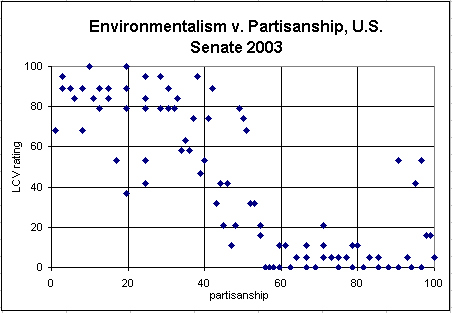
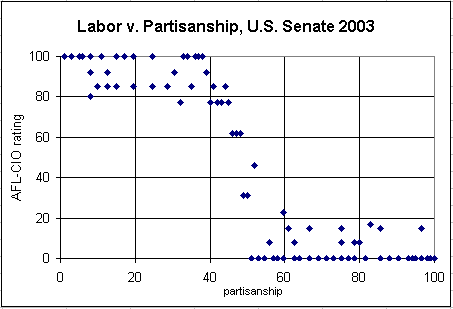
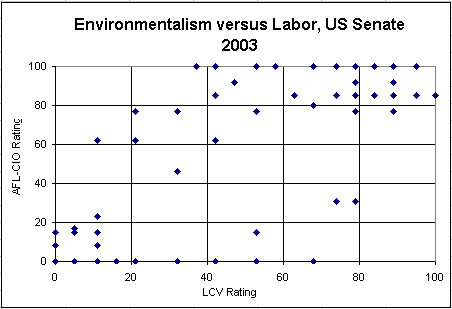
It's often assumed that environmentalism and support for labor are both central elements of modern liberalism. Certainly the far left, after the heated "red-green" battles of the later 20th century and the rise of the environmental justice movement, has more or less agreed that the two go together (if for no other reason than that "exploitation of workers" and "exploitation of nature" together provide more ammunition to use against capitalism). But in mainstream politics, you often see a more conflictual story, with environmentalism seen as a luxury of the well-off liberals. Al Gore wrestled with the issue in the 2000 race. I took notice of it again as the Democratic primary wound down, as John Edwards framed himself as being the champion of the classic labor agenda in contrast to John Kerry, who happened to be the most environmentalist of the candidates with a serious shot at winning. With Kerry's plan for raising fuel efficiency taking heat from auto workers, I thought it would be interesting to see how connected labor and environmental issues were in today's political climate.
I fired up Excel and grabbed rankings of U.S. Senators from last year. I used the optimal classification list as a measure of partisanship -- how close individuals stuck to the party line (the optimal classification procedure sorts Senators by their votes without any consideration of the content of the bills, just on who votes together). The League of Conservation Voters scorecard gave me a measure of how environmentally-friendly each Senator has been in practice. And I took the AFL-CIO rankings (pdf) as a measure of support for a classically pro-labor agenda.
The LCV scores correlate in a general way with partisanship, with clusters of Senators who are strong Democrats and strong environmentalists, and who are strong Republicans and poor environmentalists. In between, however, there is a fair amount of variation, with a noticeable number of people like Robert Byrd and John McCain who are very partisan but buck the party on environmental issues.
Support for labor, on the other hand, shows an extremely strong correlation with party loyalty.
Now let's put them together: I found this chart striking. There's almost no correlation between environmentalism and support for labor. It seems the conflict between the two is alive and well in the U.S. Senate.
Stentor Danielson, 20:11,
4.4.04
The Echo Chamber Is Beyond The Pale
Kos's callous comments on the deaths in Fallujah have spawned the predictable wave of outrage and guilt by association, and the predictable meta-commentary on how stupid the outrage cycle is. It got me thinking about whether this oft-noted phenomenon is behind the also oft-noted blogosphere echo chamber effect.
The more the focus is on "gotcha" beyond-the-pale quotes, the less you're able to read people with differing viewpoints. Part of it is a side effect of the outrage cycle -- to properly express outrage, you have to dramatically de-link the blogger in question and promise never to read him or her again. Part of it is social pressure -- you wouldn't want the Kerry campaign (link via Pandagon) or anyone else to think that, by linking and reading a certain blog, you endorse everything it says. And part of it is personal. If you focus on how outrageous and unacceptable the other side's comments are, you're less likely to see reading them as worthwhile. And if you do read them, you go into it with an intention of proving what horrible people they are rather than of engaging with their view (either to give it consideration or to disprove it). The echo chamber, in turn, makes you less sympathetic to others by separating you from them, increasing the chances that you'll say something that can be taken as beyond the pale.
Some Hegemonic Truth-Claims About The Popularity Of Relativism
Kevin Drum responds to a reader who asks why liberals get so worked up bashing the religious right, when the religious right is pretty peripheral. Drum's answer, which I broadly agree with, is that the religious right actually does wield quite a bit of power -- though I think we do tend to over-focus on the real wingnuts like Jerry Falwell and Rev. Phelps, thus hurting our ability to address the larger group of reasonable religious conservatives.
Drum's post brought up a parallel question in my mind -- why do conservatives spend so much time bashing postmodern relativism? From my perspective, relativists aren't much of a voting bloc. Even people who claim to be relativists often turn out to be realists in their practical political views. While Bush appointed Leon Kass to chair the bioethics council, I can't imagine John Kerry asking Michael Dear for input on urban planning.
My suspicion is that 1) the disproportionate number of relativists in academia, an environment familiar to people who write social/political criticism, skews people's perceptions of how many relativists are out there*, and 2) it's easier to argue against relativistic rationales for leftist political programs that can be and are supported on realist grounds.
*This availability bias probably also explains why so many liberal bloggers spend so much time criticizing libertarians -- libertarianism (as distinct from small-government conservatism, which has similar outcomes with a different philosophical grounding) may not be big in the real world, but there are loads of libertarian bloggers.
Stentor Danielson, 13:58,
Evolving A Belief In Evolution
Joe Carter has a coupleposts up recapping an argument by Alvin Plantinga (though anticipated, in a moment of self-doubt, by Darwin) that basically says that if our brains had evolved by purely natural processes, we couldn't trust them to tell us the truth about evolution. (I'm posting this now based just on Carter's explanation because if I wait to read Plantinga's full argument, I'll never get around to it.) The outline of the argument is:
1. If (naturalistic) evolution is true, then our cognitive faculties will have resulted from blind mechanisms like natural selection, working on sources of genetic variation such as random genetic mutation. 2. Assuming the truth of #1, we find that the ultimate purpose or function of our cognitive faculties, if they even have a purpose or function, will be survival - of individual, species, gene, or genotype. 3. If #1 and #2 are true then it is unlikely that our cognitive faculties have the production of true beliefs as a function. 4. If production of true beliefs is not a function of our cognitive faculties, we have no reason to trust that we can form true beliefs. 5. Therefore, we cannot claim that any belief, including a belief in the theory of macroevolution, is true.
The obvious response (interestingly similar to the defense of pragmatism as a philosophical methodology, given that pragmatism's heyday was a time when evolutionary biology was the model science) is that true beliefs have a survival value. Carter uses a story about Zed, the first Homo sapiens, to show how beliefs can have survival value without being true:
In order to survive, Zed needs to act in certain ways in order to survive. For example, he needs to avoid the saber tooth tiger taking a bite out of his big brain. We’ll call this behavior B for “tiger avoidance behavior.” Now B could be produced by Zed’s desire not to get eaten plus the true belief that B will increase his chances of not having his brain eaten.
The problem is that B could be produced by false beliefs as well. Perhaps Zed likes the idea of being eaten and wants to run toward the tiger. But Zed always confuses running toward with running away from tigers. His false belief actually aids his survival. Therefore it is possible that beliefs could have a survival advantage and yet be false.
The problem here is that we're dealing with specific individual beliefs. In such a case, it's easy to think of alternate beliefs that could produce action just as beneficial. However, that's not how the human brain works. What we have evolved is not beliefs but a belief-producing apparatus. When considering belief-producing apparatuses, it becomes less likely that they can consistently produce beneficial outcomes by a mechanism other than determining the truth about the situation. Our apparatus isn't perfect -- see Kahneman and Tversky's work on biases and heuristics -- but it's hardly surprising that evolution would be a work in progress. But it is well-developed enough that we can turn it back on itself, testing and refining our use of it so that we can get better results.
Stentor Danielson, 01:28,
 debitage


 New Source Review Finally Reviewed