|
| ||||||||||||||||
|
2003-2004 excavation at the Danielson site, Worcester MA. Yuccacentric
wockerjabby
Changed Priorities Ahead
If a word is in bold, hover over it for an explanatory note. The Shi'ite-shit pun is currently in the Kiosk.
Washington Post Sydney Morning Herald Washington Times The L.A. Times The Boston Globe Christian Science Monitor The Times-News The Morning Call Helsingin Sanomat El Nuevo Herald New York Times: Science Indian Country Today National Geographic News Yahoo! News: Environment and Nature Yahoo! News: Anthropology and Archaeology Yahoo! News: Native Americans IWPR: Central Asia Witchvox Arts & Letters Daily IndyMedia Foreign Affairs Foreign Policy Washington Monthly The Nation National Review The New Republic Weekly Standard The American Prospect Reason Grist Magazine Mother Jones TomPaine.com Worcester Magazine The Philosophers' Magazine In the Hall of Ma'at Internet Sacred Text Archive Wikipedia Daryl Cagle's Professional Cartoonists Index A Rational Animal All Facts and Opinions American Dissent Apathy, Inc. Appalachia Alumni Association Arms and the Man ArtMachine Augustine's Blog blunted on reality Brainysmurf Democratic Veteran Dohiyi Mir Dru Blood fantastic planet Folkbum's Rambles and Rants genfoods.net Half the Sins of Mankind In a Dark Time Interesting Monstah Mark A.R. Kleiman Mediocre Fred's Mediocre Blog Modulator Nitpicker Notes on the Atrocities Nurse Ratched's Notebook Out2Lunch Pacific Views Persian Garden Plucky Punk Professor Kim's News Notes Prometheus 6 rantavation Redeye's Corner Resource.full Rook's Rant Rush Limbaughtomy Sadly, no! Suburban Guerilla Subversive harmony T. Rex's Guide to Life The Blowtorch Monkey Armada The Conch The Fulcrum The Funny Farm The Mad Prophet Blog The Mahablog The Peking Duck The People's Republic of Seabrook The Poison Kitchen The Village Gate The River Thudfactor Thikun Olam To the Barricades! veiled4allah © Eemeet Meeker Online Enterprises, to the extent that slapping up a copyright notice constitutes actual copyright protection. |
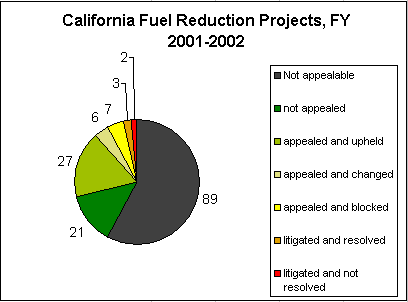
17.4.04 Let me sum up what I've found with regard to the California Governor's Blue Ribbon Fire Commission report (enormous pdf): I've made it to the point in the 2003 fires inquiry report where they elaborate on the recommendation that environmental laws need to be streamlined to enable swifter fuel reductions. The elaboration doesn't provide much in the way of additional detail. In fact, only two data points are offered (though that's consistent with the presentation of the remainder of the findings and recommendations). There's a quote in the margin from Mayor Judith Valles of the City of San Bernardino claiming to have had a fuel reduction project stalled by the Fish and Wildlife Service (which for all we know could have been a justified move -- there's no reason to suppose that all proposed fuel reduction projects are good, even from a strictly fire safety standpoint).
I'm still not done reading the actual report (some blogger I am), but I came across this little item that gives some more specifics about how environmental laws conflict with fire protection. But this is still a one-source assessment, as Campbell is the one who wrote the introductory letter to the report that played up the environmental aspect so much more than the report's executive summary. Stentor Danielson, 01:16, 16.4.04 I've largely stopped doing posts about Iraq and terrorism (there are hundreds of people doing it better than me), but this caught my eye:
The offer is meant to drive a wedge, but not between the US and Europe. It's to drive a wedge between the West and Muslims potentially sympathetic to al-Qaida. The idea of this as a US-Europe wedge (similar to Saddam's grudging concessions on weapons inspections) assumes that Europe might accept the offer. Certainly many countries would like to reconsider their foreign policy in order to avoid angering Islamists. But they would not do so in the context of coming to an agreement with bin Laden. If anything, his making the offer will make them less likely to withdraw, because they won't want to seem like they're capitulating to terrorism. And I see no reason why anyone would trust al-Qaida -- they'd soon enough find a reason to implicate Europe in anti-Muslim activities. If he could reason that the people in the World Trade Center were guilty of crimes against Islam because of their association with the US, certainly he can find some way to blame Europe no matter what they do. The offer, I think, was made on the assumption that Europe would turn it down. Now bin Laden can say "I offered to call off terrorism if Europe agreed to not attack Muslims. Europe said no. Therefore they're intent on attacking Muslims." This then provides a justification for his activities, and a proof to his sympathizers that the West is against them. Stentor Danielson, 17:27, I held off on posting my comics and commentary yesterday because I had other things I wanted to post (like the conclusion to my post about the California wildfires inquiry), and I wanted to pace myself. Then I wound up not posting any of those things. So here, a day late, are my contributions to the year's penultimate issue of the Scarlet: Today in my decisionmaking class, we did a game theory exercise. We formed into small groups, and within each group each person represented a town that wanted to build a wastewater treatment plant. We had a list of net savings that we could gain by forming coalitions to build joint plants between two or more towns. The idea was that we would each bargain, trying to get the best deal for our own town, by shifting alliances and offering better savings allocations to entice other towns into cooperating with us. The game was deliberately designed to be unstable (i.e., to have no final solution that everyone would be happy with, and thus to be open to endless shifting and backstabbing). Matthew Yglesias points out Brian Leiter's post on C-250, which is a refreshingly honest example of "embracing intolerance when possible, and resorting to tolerance when necessary." David Bernstein is wont to point out stories like the following*:
Assuming that the writer is presenting the cases fairly, they're pretty frightening. The usual response is first to assert a commitment to free speech (as a moral principle even in cases when the First Amendment doesn't apply), and second to point out the irony that the promulgators of PC speech restrictions got the power they have today because of the free speech that their opponents accorded to them in the recent past. We might then move on to suggest that they simply suffer from the all-too-common human failing of embracing intolerance when possible, and resorting to tolerance when necessary. (I've been tossing around the idea of how one could construct a left-but-not-liberal justification for restrictions on speech, something along the lines of the idea that discourses have power and that concepts like the marketplace of ideas and "sticks and stones may break my bones but words will never hurt me" are luxuries of the privileged class. But I'll leave that for another day.) But what strikes me is how bill C-250 delegitimizes the very gay rights movement it seeks to defend. Under a deliberative conception of democracy (a la Habermas), the ideal case of a securely justified law is one in which all citizens affected by it have been rationally persuaded to accept it. To make an argument or proposal in a democratic system is to offer your view as a candidate that could be accepted in such a fashion (or at least it is to attempt to have your hearers believe that that is what you are doing). An idea can only be truly and completely beyond the pale after such a consensus has been reached, because in that case anyone expressing a different view is ipso facto not doing so rationally, and thus is subject to non-rational (i.e. coercive, if only in the loose sense of pressure and shame) measures to change their view. Of course, the practical barriers to such an ideal are legion, including such varied constraints as the limits of the human mind, the limits of science to produce reliable empirical inputs, and the logistics of carrying out such deliberation across space and time. Thus we have the system of provisional consensus. After a good faith effort to do some deliberating, we take some mechanism -- such as a majority vote -- to come to a resolution. However, that resolution is regarded as legitimate by those on the losing end precisely because it is provisional -- i.e., it is open to being challenged at a later date, at which time the losers can reopen the issue and try again. What measures like bill C-250 attempt to do is to make a provisional agreement on the legitimacy of homoseuxality into a functionally final consensus. They declare opposing views to be beyond the pale, and subject to coercive (in the strict sense) regulation as if all rational people had accepted homosexuality. However, the agreement on the acceptability of homosexuality is legitimate precisely because of its provisionality, the invitation it extended to gay rights foes to try again later. To take that invitation away through criminalizing the opposing view removes the reason for opponents to grant even provisional legitimacy to the laws regarding homosexuality. With that legitimacy withdrawn, the laws "defended" by C-250 are no longer morally legitimate and binding on all people of Canada. To put it in short form: You are only morally bound to obey laws that you are free to disagree with. A law banning disagreement is self-refuting, or at least refuting of the policy it seeks to defend -- the article in question doesn't make it clear whether it would be a crime to say "C-250 is wrong," or just "homosexuality is wrong." In the case of the latter, there remains a two-stage process for overturning the provisional consensus -- you first argue against C-250 to get it repealed, at which point you regain the freedom to argue against homoseuxality. Yet while it may be theoretically justifiable, the practical difficulties associated with it make it effectively self-refuting. *It would be great if he wrote a book about them or something ... Stentor Danielson, 02:09, 14.4.04
Whether it be rational or just an effect of being raised on stories of the righteous revolution against King George, I have an undeniable sympathy for the republican cause. However, I can largely agree with the monarchist argument as presented in the article -- Britain's rule is so ceremonial that, particularly if the Westminster system stays in place, the republican movement is expending a lot of energy on a trivial matter. I can understand the desire to make the transition as palatable and smooth as possible by not rocking the boat, but perhaps they'd get more bang for their buck by introducing additional reforms -- like a bill of rights, separating the executive and legislative branches, or scrapping mandatory voting* -- along with the transition to full independence. Nevertheless, if the monarchists' argument is merely "if it ain't broke, don't fix it," it seems that that attitude ought to lead to apathy, not organized opposition to the republicans. Such was the case for me when Colgate had its big controversy over introducing the Honor Code, which -- despite the hysterical claims of its supporters and detractors in The Maroon-News -- changed almost nothing. It seems unlikely, given the trend of public opinion, that a concerted monarchist effort could squash the republican movement quickly enough to save more total effort and expense that way than would be saved by acquiescing to the change. *This list is perhaps more evidence of my being socialized into thinking the American way makes the most sense. Stentor Danielson, 23:29,
I'll admit to having a bit of a knee-jerk reaction against this claim, since unfairly blaming environmentalists for the ill effects of fire has been a tactic used in promoting the Healthy Forests Initiative. But the storyline that environmental regulations hamper fire safety is not inherently implausible, and there are certain tradeoffs between ecosystem and safety values, so southern California may be a case where it actually happens. Let's go to the report itself (enormous pdf). I haven't gotten past the executive summary yet, but the story it paints is somewhat different. The introductory letters reflect the emphasis of the AP story on environmental laws as major contributors to the problem. But in the list of findings, the only one that deals with environmental laws is Finding 2:
If that's a fair summary of the finding, then it seems to be little help to deregulators and little threat to environmentalists. The problem as described seems to be not with the scope of environmental laws, but with their interjurisdictional confusion. It's not surprising that firefighters being shuttled off to counties and states they aren't familiar with would be tripped up by a patchwork of differing local regulations. The report goes on to note that fuel accumulation was a major factor, but it is not linked -- as it is in the news story -- to environmental laws. No clear explanation is given in the executive summary, but I can offer one example in which it was disaster aid structure, not environmentalism, that contributed to fuel buildup. California was hit by a beetle infestation that left large swaths of forest dead, prime fuel for a catastrophic fire. County officials tried to get funding to pay for clearing the trees over a year in advance. However, they were turned down first by the state, and later by the feds. The justification was that a state of emergency could only be declared, and the funds resulting from that used, after a disaster had taken place, not for preventative measures. Moving on to the recommendations, there is again only one that really confronts the issue of environmental laws. Rated as high-priority, it says:
This suggests a more straightforward environment vs fire safety problem. However, the recommendation is quite vague. This contrasts with the recommendations relating to communications, training, and insurance, which are generally fairly specific. More to come as I read the remaining 200 pages ... Stentor Danielson, 19:34, Since the nature-nurture thing came up in the previous post, I'd like to point out something that annoys me about assessments of some theoretical debates. People like to declare that debates like nature-nurture in psychology and structure-agency in sociology are settled or passe because the hardliners for each position have admitted that the real explanation is somewhere in between. I agree that in these cases, "a little from column A and a little from column B" is correct, but it's also not terribly specific. There remains a lot to be asked about what from column A and how much from column B. The problem is how you argue that without your opponents building straw men, or without radicalizing your own position -- e.g. taking a hard-line agency viewpoint in order to get more leverage to move the compromise solution a skosh away from the structure side.
I agree entirely with the comment by ampersand, who was like Matt growing up:
I wonder how many of the boys on Matt's soccer team would have been happier at cooking camp with him, but who lacked either the personal strength or the parental support to be different, and thus slipped into conformity with gender expectations and into enforcement of those expectations against Matt. What interested me, though, is the author's secret wish to burnish her feminist credentials by having a tomboy daughter and a sensitive son*. I can understand the desire. Gender roles need loosening, and that's more likely to happen if the Matts of the world are paired with the feminist parents like this author. It's an unfair burden to place on the shoulders of a kid just for being different, but it would perhaps be even more unfair to assign the duty of challenging gender stereotypes to a boy who really just wants to play soccer (though such a boy would have at the least the duty to not enforce any role, whatever it may be, on others). More significant, perhaps, is the concern for confirming the anti-feminist view of immutable gender. If Matt had been more like Liza, it would be a constant reminder to his mother that some boys really will just be boys. (Or it could be a suggestion that she failed to keep society from enforcing its gender roles on Matt.) But the way the author expresses it makes it sound like a desire to set up a counter-hegemony, in which being sensitive is properly masculine, but being traditionally "boyish" is bad. Wouldn't it be better to take a "thy will be done" approach, letting Matt's personality be dictated not by social gender roles or resistance thereto, but by his inherent personality, will, and experience? The latter sounds nice, but Foucault** suggests reason for pessimism about the possibility. He argues that once society creates categories, it's very difficult to get them to go away. Their presence in society practically forces us to think with reference to them. We get trapped in second-guessing about whether deep down we might be conforming or being contrarian for the sake of being contrarian***. And the bigger the role "nurture" plays in personality development, the harder it is to get outside the categories, because the nurture you experience is coming from a world impregnated with those categories. In such a situation, can there really be an "authentic self" independent of social construction? Perhaps some degree of "nature" is necessary to introduce an unavoidable bit of variation as an anomaly to call into question, even falsify, the prevailing gender paradigm. Alternately, maybe we need some other categorization of personality, built on a more justified basis, that we can use to distract ourselves the gender categories so that they can fade into the background and lose some of their power. *Interestingly, Matt is not just of a non-dominant form of masculinity (like being a "gamer geek"), but is positively feminine. **I'm citing a social theorist other than Habermas! Whoa! ***For example, I wrote that passage in a sort of universalizing language that many feminists would argue is typically (and problematically) male. So I considered contextualizing it into my personal second-guessing about my own masculinity. But would I be doing that just to prove that I'm not falling into hegemonic male discourse patterns? If all knowledge is as radically situated and contextual as some feminists make it out to be, I don't even have the "out" of saying that one way of framing my point is objectively better than the other independent of its gender connotations. Stentor Danielson, 13:09, 13.4.04 I recently read a study by Greg Winter and Jeremy Fried, which asked some northern Michigan homeowners about their perceptions of wildfire. One interesting finding was that the respondents generally blamed temporary residents and tourists from downstate for starting the fires, through a combination of carelessness and lack of knowledge about the local environment. Discussing this with one of my professors, he said that he noted a similar phenomenon in his study area of southern California -- people there generally blamed illegal immigrants for starting fires. In both cases, the blame seems misplaced. Winter and Fried said that according to state records, the main source of fires was residents' backyards. In the case of illegal immigrants, it seems logical that they would have a strong incentive not to let their fires get anywhere near uncontrollable proportions -- both for their own safety and to avoid attracting the attention of the Border Patrol with even a large-but-under-control fire. 11.4.04 This article in Reason reminded me that I haven't updated the Kiosk recently. Now, I realize that editors like to come up with catchy headlines, and that puns are one way to do that. But when your pun is either overused or stupid, it makes the headline worse than if it were boring and informative. In honor of one of the worst such puns, gaining in popularity since the US entangled itself in Iraqi ethnic/religious conflict, I am placing the Shi'ite-shit pun in the Kiosk.
No insightful comments at the moment, I just thought it was worth passing along. Stentor Danielson, 15:24,
Well, if they're trying to sell a policy of logging, doesn't it make sense to contrast today's forests to a post-logging scene? The brochure says "Please do not confuse the tree-thinning and underbrush-removal projects of this campaign with the logging operations of decades ago." Sounds like advice the brochure designers could stand to hear. On the other hand, the Swan View Coalition points out that "fuel treatment" in Montana produced a scene remarkably similar to the post-logging one. The pamphlet in question is here. Treating the photos as diagrams of fuel loads rather than records of the Sierra Nevada's history, the description given of the relative dangers of parklike versus dense forest, and the increase in the latter, is unobjectionable until (near the bottom of the page) they use the word "natural." Obviously the 1909 photo does not depict a natural condition. But neither is it being used as a stand-in for a natural Sierra Nevada ecosystem. The parklike forest that covered much of the west around the turn of the century (when the Forest Service and National Parks Service were created and began land management) was a human artifact. Centuries of burning by Native Americans was aimed at creating such a parklike environment, which was more conducive to hunting and travel as well as being safer from conflagrations. This practice -- derisively called "Paiute forestry" by foresters trained in the European forest-as-garden tradition -- was continued by early white settlers. Had the land been left in a fully "natural" state, fires would have been rarer and more intense. Indeed, some pine species need crown fires to reproduce optimally. The current fuel loads go far beyond anything natural, but ongoing management is necessary to keep them at "safe" levels. The Swan View Coalition provides us with a photo of the Montana scene prior to the 1909 logging. The density of trees is greater than post-logging, of course, and there looks to be a substantial bed of grass on the forest floor. However, it is still a relatively fire-safe environment (likely due to past Native American and white settler burning). Noticeably, it lacks the profusion of understory ladder fuels visible in subsequent photos. (And to do my required allotment of griping about "he said, she said" journalism, the article says "Hanson said the Sierra Nevada is the only region discussed." Since there's a link to the Forest Service page right there in the article, you'd think the reporter could have taken a few minutes to read the brochure and verify this claim.) Stentor Danielson, 15:17, |
|||||||||||||||
 debitage


 California Wrapup